


















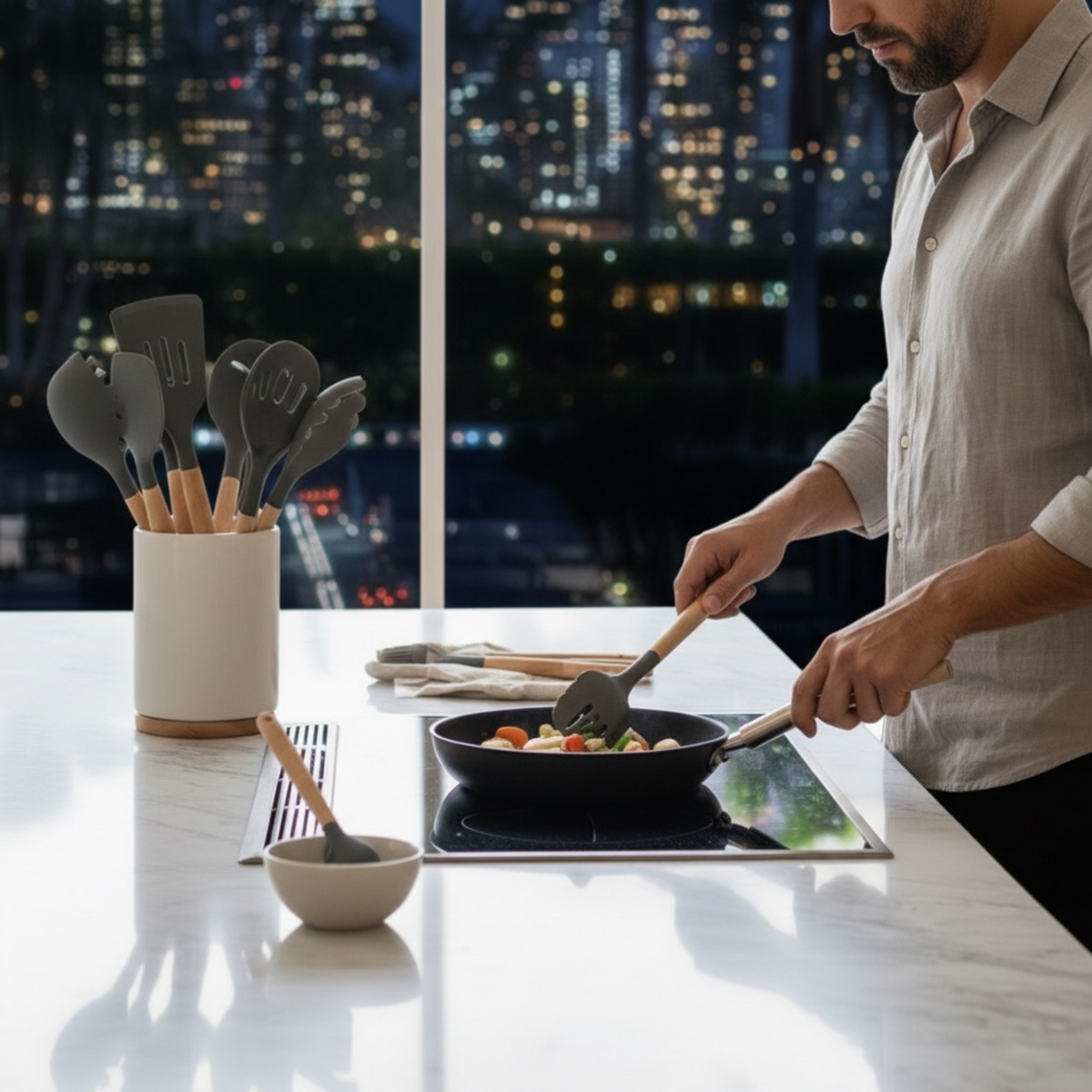
The short answer
Choose a kitchen utensil set by matching its working shapes to your meals, its construction to your cookware, and its care to your routine. Count useful tools rather than every piece in the package. A set makes sense when several of its utensils have a clear job; individual tools can be better when you only need one missing shape.
The right spoon usually gets there first.
It’s the one you reach for when the sauce needs stirring. The turner beside it handles breakfast. Another tool looks lovely in the holder but rarely leaves it.
A good utensil collection grows around those differences. You want tools that feel at home with your pans, leave room for your hand to work, and return somewhere sensible after dinner.
A coordinated set can bring that arrangement together. The useful question is whether its pieces match your cooking—not whether every handle in the kitchen will finally agree on a color.
Our Home & Kitchen essentials guide covers the wider kitchen. Here, we focus on choosing a utensil set, including the shapes, materials, and storage details that make the decision more specific.
Start With Three Meals You Make Often
Choose three familiar meals and list the actions involved. Stirring, lifting, draining, scraping, and serving give you a more useful starting point than a long package list.
Name the Action, Then the Tool
Take pasta with a sauce. You may stir the sauce, lift or drain the pasta, and serve both. Breakfast might require a turner that fits your pan. Soup brings a different question: how comfortably can you stir the pot and transfer a portion to a bowl?
Write the meal, the action, and the tool you currently use. Then note anything that could work better. Perhaps the spoon is comfortable but the turner is too broad for a smaller pan. That points toward a particular shape, not an entirely new kitchen.
Use this short worksheet:
- The meal: something you make regularly.
- The action: what your hand and the utensil need to do.
- The existing tool: what already handles the job.
- The useful change: a missing function, a different shape, or an extra tool you genuinely need.
Keep the Tool You Already Like
A familiar spoon can stay beside a newer set. Matching is an aesthetic choice, not a cooking requirement.
Look at the tools you use during the same meal, too. Two similar spoons may be useful when you’re preparing separate dishes. Several nearly identical tools add less when they compete for the same occasional job.
This small review gives the next purchase a purpose before you choose its color or storage holder.
Choose Working Shapes Before Counting Pieces
Compare the edge, width, depth, reach, and support each task needs. Similar-looking utensils can behave differently, and the word “spatula” can describe more than one shape.
A Turner and a Scraper Have Different Jobs
A turner needs to get beneath food and support it as you lift. A flexible scraper needs an edge that reaches around a bowl. One tool may handle several tasks, but that doesn’t make every broad, flat head interchangeable.
For spoons, think about the contents. A deeper bowl may suit serving liquid; slots allow liquid to drain. For a whisk, the head must move comfortably inside the vessel you use. The name is useful, but the working shape tells you more.
| Cooking action | Shape to compare | Useful fit question |
|---|---|---|
| Turn food in a pan | Leading edge, head width, and support. | Can the tool get beneath the food and move within the pan? |
| Scrape a mixing bowl | Edge flexibility and head profile. | Does the shape reach the curve where ingredients collect? |
| Stir a deeper pot | Handle reach, head shape, and permitted use. | Can you work comfortably with that pot’s depth and opening? |
| Serve soup or sauce | Bowl depth and pouring shape. | Does it suit the pot and the bowl or plate receiving the food? |
| Lift food while draining liquid | Slots or openings and supporting surface. | Will the food be supported while the liquid drains? |
These are general comparisons, not a claim that a particular set contains every tool shown.
Look Beyond the Total on the Box
A holder, hook, measuring accessory, or duplicate can contribute to a package’s piece count. Each may be useful, but they don’t all perform another cooking function.
Read the itemized contents and mark the pieces that match your meal worksheet. Give duplicates a reason: simultaneous cooking, separate preparation tasks, or a shape you use often.
Finally, consider grip and retrieval. A long handle may reach your pot but catch beneath a cabinet when lifted from a holder. A broad head may serve well yet make the drawer awkward. The tool has to fit the journey between storage, cooking, and washing.
Match Materials to the Pan and the Job
Choose the complete utensil for its intended use, not a material name in isolation. The head, handle, internal support, joints, and care instructions all belong in the comparison.
Silicone, Wood, and Metal Are Starting Points
Silicone tools can offer flexible working edges, but the firmness and internal construction differ. Wood tools can provide a firm stirring shape and a finish you enjoy seeing. Metal tools may offer a thin edge or rigid support. None of those descriptions establishes suitability for every pan or cooking method.
Start with your cookware’s instructions. Where a pan calls for particular utensil materials, use that information to narrow the choice. A universal “will not scratch” statement is less useful than compatibility with the cookware you own.
The FDA’s food-contact-substances information explains the regulatory context for materials that contact food. That is different from identifying a particular finished utensil as suitable for every cooking condition.
Choose the material and the shape together. A soft edge that suits scraping may not provide the support you want for lifting. A comfortable stirring tool does not automatically replace a turner.
Read the Whole Tool’s Limits
For mixed-material utensils, distinguish the head from the handle and any connecting parts. A temperature statement for one component should not be extended to the entire tool.
The FDA’s food types and conditions-of-use tables distinguish different food-contact settings, including storage and heating conditions. The practical lesson is to match permission to the actual job rather than treating one broad label as complete instructions.
Read any documented temperature limit with its conditions. It is not automatic permission for direct flame, oven use, or leaving the utensil resting against hot cookware. Likewise, a silicone head does not establish the care requirements of a wooden, metal, or otherwise constructed handle.
Decide Whether a Set or Individual Tools Fits Better
Choose a set when several included tools meet real needs under care requirements that suit you. Choose individual tools when the useful gap is specific.
A Set Makes Sense When Several Gaps Line Up
If you’re establishing a kitchen, a set can bring together several familiar functions in one purchase. Compare its actual contents with your meals, pans, and available storage rather than assuming “complete” means complete for you.
A coordinated appearance can be part of the appeal. One repeated color or finish may make a visible group feel intentional. Let that be a benefit alongside useful shapes, not a substitute for them.
Remember that a utensil set is not necessarily a complete kitchen kit. Knives, cutting boards, food thermometers, and other basics have separate roles.
Individual Tools Suit a Specific Missing Job
Imagine your pasta tools already work well, your soup ladle fits its pot, and breakfast is the only awkward task. A better-suited turner addresses that need directly.
Now imagine you have a few borrowed tools and regularly need to stir, turn, scrape, and serve. A set containing suitable versions of those tools may be a more coherent starting point. These are illustrative decisions, not fixed shopping lists.
Buying for someone else? Use their cooking and existing tools as the starting point. Our gifts for home cooks guide takes that recipient-first approach further.
Give the Tools Somewhere to Dry and Live
Choose the cleaning and storage arrangement along with the utensils. A useful tool should be straightforward to clean, dry, retrieve, and put away.
Choose the Cleanup You’ll Actually Use
If dishwasher cleaning matters to you, look for permission covering the complete item. Do not infer it from the head material. Mixed construction, removable parts, and fixed joints can change the care required.
Notice where food might collect and how those areas can be reached using the permitted cleaning method. A joint is not automatically a problem; an unexplained cleaning arrangement is a question worth resolving.
The FDA’s safe-food-handling guidance recommends washing utensils and preparation surfaces with hot, soapy water after preparing each food item. Choose tools whose documented care lets you clean them appropriately, including between handling raw foods and ready-to-eat ingredients.
Allow the pieces to dry as directed before storage. A holder that keeps everything close together still needs to fit the care routine of the utensils inside it.
Choose a Drawer or Holder Deliberately
A drawer keeps the counter visually quiet. Measure its usable length and opening height, then consider how the largest heads will sit. Packing the drawer tightly can make one utensil surprisingly good at keeping all the others inside.
A holder keeps a small group visible. Compare its base footprint, height, and the room needed to lift tools out. Position it away from heat and splashes, following relevant appliance and product instructions.
You can also divide the collection: frequently used tools in one accessible place and occasional pieces nearby. A matching set does not have to remain together as a display.
Compare Love Dug’s Set With Your Shortlist
Bring a short list of required jobs to the product page. It turns a broad search for kitchen tools into a comparison you can finish.
Write a Five-Line Buying Brief
- Meals: the familiar dishes the tools will support.
- Shapes: the turning, stirring, scraping, or serving functions you need.
- Cookware: the utensils permitted by your pans’ instructions.
- Care: the finished-item cleaning and drying routine you can accommodate.
- Storage: the drawer or holder space, including retrieval.
Then read the exact package contents. A set earns its place when the included pieces meet that brief—not when the photograph happens to match your kitchen towels.
Explore the Food-Grade Silicone Kitchen Set
For the meals you make
Explore Love Dug’s Food-Grade Silicone Kitchen Set with your shortlist beside you. Compare the current option’s included tools, construction, dimensions, and care with your cookware and available space.
If a detail determines whether the set will work for you, ask about that exact option before ordering.
Kitchen Utensil Set Questions
The useful answer usually comes back to the meal, the complete tool, and the instructions for what it touches.
How Many Pieces Should a Kitchen Utensil Set Have?
There is no single useful count for every kitchen. List the cooking functions you need, then compare the itemized contents. Holders, hooks, and duplicate shapes can increase the total without filling another gap.
Are Silicone Utensils Suitable for Every Nonstick Pan?
Do not assume universal compatibility. Follow the cookware manufacturer’s requirements and the utensil’s intended use. Material, construction, condition, and the task all matter.
Can Silicone Utensils Go in the Dishwasher?
Only when the instructions permit dishwasher cleaning for the complete item. A silicone head does not establish that a different handle, joint, or internal construction can receive the same treatment.
What Does “Food-Grade” Tell Me?
It describes a food-contact claim, but it does not by itself establish a particular utensil’s temperature limit, cookware compatibility, cleaning method, or certification. The FDA’s food-contact information provides general regulatory context; the finished product still needs clear information for its intended use.
A few useful shapes, ready for dinner.
Keep the tools you enjoy using. Choose the next ones for a meal, a pan, and a place in the kitchen. A coordinated set is most satisfying when its pieces belong in the cooking as naturally as they belong beside one another.
Sources and Updates
This guide uses an original meal-to-tool worksheet and illustrative kitchen examples. It does not report hands-on product testing. General food-contact and handling guidance does not verify the featured set’s composition, package contents, temperature limits, or performance.
Use the instructions for the exact utensils and cookware you are considering. Revisit the comparison when a product’s contents, construction, or care information changes.
Selected sources
Read more
A weekend bag, something for the table, and a comfortable drive. Pack around planned stops, arrival, and the space you’ll want for the trip home.

One warm waffle with coffee, or breakfast for everyone at once? Choose a mini waffle maker around the plates you want to fill, the counter you use, and the cleanup.