
















The short answer
Choose a cookbook stand around the book you actually use: how it opens, how its lower edge rests, and whether you can read and turn the pages comfortably. Then compare the space needed by the stand and open book with your working counter. Book support, reading position, and storage should make the shortlist before the finish.
The ingredients are ready. The cookbook has other plans.
It closes just as you reach for the next ingredient, or lies open in the space you need for the cutting board. A stand may help, but the useful choice is the one that suits the book and leaves room for the cooking.
A slim weeknight cookbook and a substantial baking book can ask different things of a holder. Start with the recipes you return to, the way their pages open, and where you want to read them.
Our Home & Kitchen essentials guide covers the wider preparation space. Here, a book-and-counter worksheet helps you turn those everyday details into a clear buying brief.
Start With the Cookbook You Actually Use
Choose for your regular cooking book first. Then consider any unusually large, thick, or delicate book you also want to use, rather than assuming one example represents them all.
Choose Your Everyday Reference
Take out the cookbook you reach for most often and open it to a familiar recipe. Notice how it rests without pressing it down. Does it stay open easily? Do the covers need support? Is the recipe on one page, across facing pages, or continued overleaf?
The Library of Congress advises supporting an open book without forcing it completely flat. Work with the opening the binding allows comfortably. A book that resists opening needs a different assessment from one that naturally lies open.
Name the Reading Task
Perhaps you want to glance at ingredients while measuring, follow a baking sequence, or keep a recipe visible across a shared island. Decide whether the stand will remain in one position or move between preparation areas. That gives the product a specific job before appearance enters the decision.
If you mostly cook from loose recipe sheets, assess how those sheets would be supported. There is little reason to choose around an oversized hardcover you rarely open when your everyday recipe needs something different.
Make a Book-and-Counter Fit Note
Record the book's closed measurements, its comfortable open spread, and the space available for the loaded stand. Each answers a different fit question.
Measure the Closed Book and Open Spread
Use a ruler or tape measure and record inches consistently. Measure the closed cover's width and height, then the book's thickness without compressing it. Open it gently to your chosen recipe and note the spread's width in a supported position, without pulling it flatter.
Keep the book's title beside the measurements. If you are comparing two cookbooks, give each its own entry rather than combining the widest cover from one with the greatest thickness from the other.
| Fit detail | What to record | What to compare |
|---|---|---|
| Closed cover | The book's width and height. | The stand's stated book-size guidance and support arrangement. |
| Book thickness | Closed thickness, including the covers. | Usable ledge depth and any stated thickness limit. |
| Open spread | Width at a comfortable, supported opening. | Support for the open book and space beside the stand. |
| Lower page area | The position of the lowest recipe lines and notes. | Whether a front lip, rail, or page support would cover them. |
| Working counter | Available width and depth with your usual preparation tools in place. | The assembled stand's footprint and the open book's projection. |
| Storage space | The usable opening and interior of the intended drawer or shelf. | The stand's stored dimensions, including separate pieces. |
Compare the Same Measurements
A dimension labeled “width” might describe the base, the back support, or a recommended book size. The overall depth of a stand is not the same as the usable depth of its ledge. Look for a labeled diagram or an explanation of what was measured before comparing the numbers.
Closed thickness is a useful starting point, but it does not establish how an open book will rest against a particular support. For a substantial cookbook, also record its weight in pounds if you can measure it and ask about the supported load.
Your fit note should leave you with specific questions: how this book rests, how much room the complete arrangement needs, and where it goes afterward. A rough sketch can help, but a short written record is enough.
Check the Ledge and the Way Pages Turn
Look at where the book rests, what supports it from behind, and how you reach the next page. Supporting a book and keeping its pages open are separate jobs.
Look at the Usable Ledge
Start with the surface that receives the book's lower edge. Look for a clear side view showing the ledge and any raised lip. Consider where the covers and pages would sit together, particularly when a thick book has a pronounced spine.
Then examine the back support. Does the product information explain how the book rests against it? A photograph can help you understand the arrangement, but it cannot establish a supported weight or confirm fit for a different book.
Read the Bottom Lines and Turn the Page
Look at the lowest lines of a recipe you use often. A front lip or page support should not leave you lifting the book repeatedly to read an instruction. If you can inspect a display model or a stand you already own, use an ordinary, sound book to assess page access.
Try pages near the beginning, middle, and end. Notice whether turning a page requires lifting the book, moving a support, or repositioning the whole arrangement. Choose the interaction you would be comfortable repeating while cooking.
For a valued cookbook, avoid improvised clips that grip the paper tightly. In the National Archives' guidance on preserving books, Mary Lynn Ritzenthaler warns that metal devices clipped over page tops can tear or distort paper. A reluctant book is not a reason to force its pages into place.
Give the Stand a Place in Your Kitchen
Plan for the stand and open book together, alongside the tools you actually use. A compact base does not necessarily mean a compact working arrangement.
Leave Room for Preparation
Put your usual cutting board, mixing bowl, and measuring tools on the counter first. Then identify a dry place for the recipe. Allow room for the book's edges, the rear support, and your hand when a page needs turning.
Open nearby cabinet doors and drawers, and consider where ingredients will wait. If the recipe position blocks a frequently used cupboard or the place where you set down a bowl, try another location before choosing a smaller-looking stand.
Keep the book and holder away from the stovetop and out of hot-appliance operating space. The U.S. Fire Administration advises keeping combustible items away from the stovetop. Follow the appliance's required clearances rather than choosing a distance from a styled kitchen photograph.
Check the View From Where You Cook
Assess the page from your usual standing or seated position. Can you read the smallest instruction without moving the bowl? Notice shadows and reflections as well as the angle. If another person regularly cooks with you, consider their view too.
A fixed reading position may suit one familiar spot. If you want to use the stand in several places, put adjustment on your comparison list rather than assuming one angle will work everywhere.
Choose a Format That Fits the Routine
Separate the reading position from the storage method. Choose the features that serve those two jobs, then consider the finish you would enjoy seeing in the kitchen.
- Fixed-position support: A format to consider for one regular reading spot. Compare its angle and book support with that particular use.
- Adjustable support: Worth considering when different books or reading positions require a change. Look for clear adjustment instructions and a way to secure the selected position.
- Fold-away support: Check how the design closes and measure its stored shape, including any projecting parts.
- Take-apart support: Check how the pieces separate and whether they can share a convenient storage place.
These characteristics can overlap. A stand may be adjustable and fold for storage, or use one reading position and separate into pieces. The storage action tells you something different from the range of reading angles.
If you intend to leave the holder on display, consider its appearance with and without a book. If it will spend most of its time in a drawer, put more weight on the stored arrangement and the effort of taking it out.
Where Our Wooden Stand Fits
Explore Love Dug's option
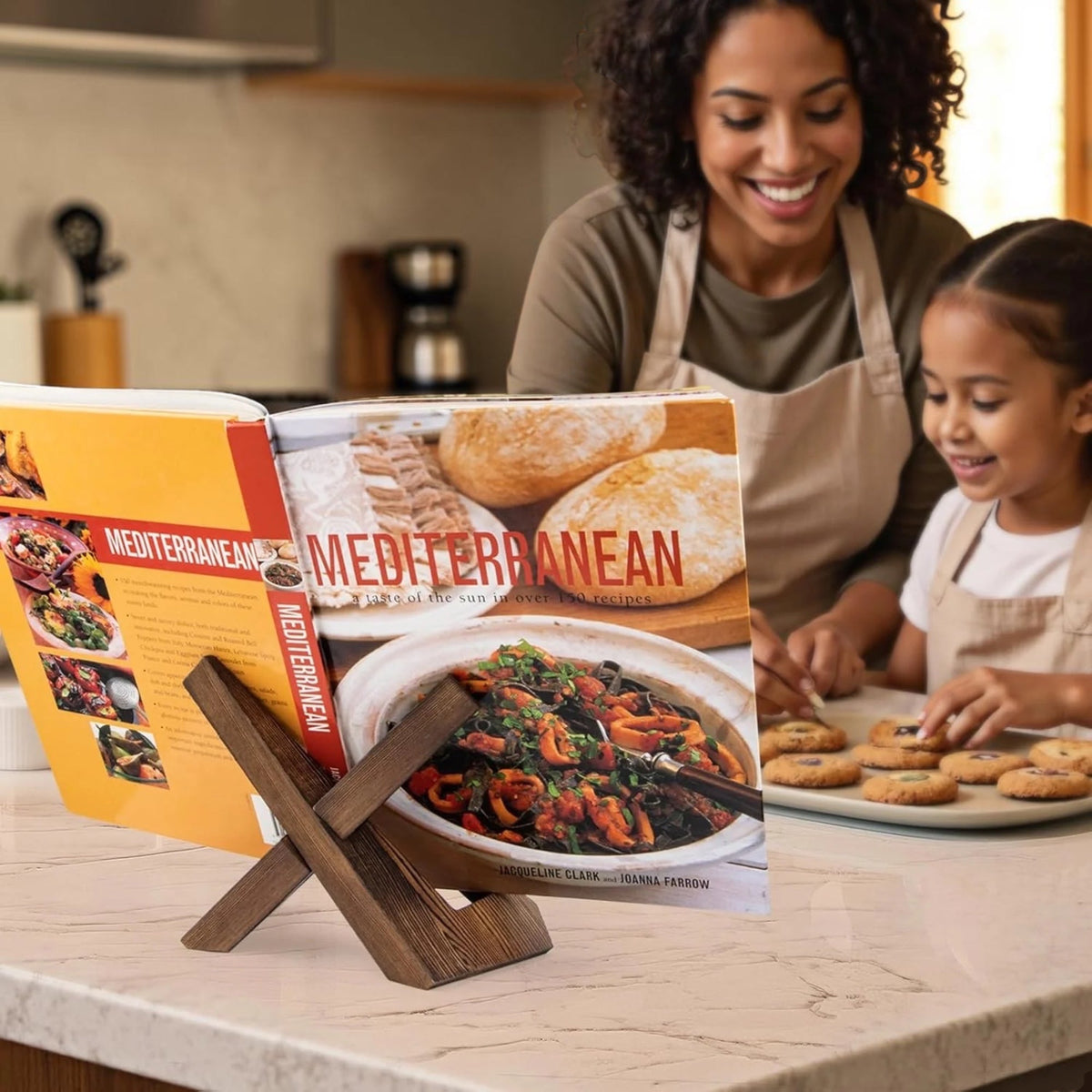
Our Rustic Wooden Cookbook Stand uses two interlocking wooden pieces that separate for storage. Consider it if you want a wooden holder with a take-apart storage arrangement.
Compare the current product details with your book-and-counter fit note. For a thick or heavy cookbook, resolve ledge depth and supported load before deciding.
To ask a useful fit question, contact Love Dug with your cookbook's measurements, its weight if available, and the counter space you plan to use. Those details make the question more specific than whether a stand holds “large books.”
Think Through Cleanup and Storage
Include page handling, care, and putting the stand away in your decision. The arrangement should make sense after cooking as well as before it.
Read through the recipe before starting so you know when a page turn is coming. For food-preparation hygiene, the FDA recommends washing hands with warm water and soap for at least 20 seconds before and after handling food. Dry your hands before returning to the book.
Choose Care for the Finished Stand
Look for instructions that apply to the complete item, including its finish, joints, and attached parts. A wooden cookbook holder does not automatically share a cutting board's washing or oiling routine. If the permitted cleaning method is missing, resolve that question before buying.
Think about where the stand will sit between uses, too. Choose a place away from the sink's splash area rather than relying on the holder to protect the book from every spill.
Give the Pieces a Storage Place
Decide whether the stand will remain assembled beside the cookbooks or go into a drawer after dinner. Measure the storage opening as well as the interior: an item needs to pass through the opening before it can occupy the space inside.
For a take-apart design, plan where both pieces will stay together. A convenient shelf may suit your routine better than a crowded drawer. If the counter becomes a workspace after dinner, include the time and movements needed to clear it.
Turn Your Notes Into a Clear Choice
Choose around the requirement that matters most in your kitchen. A feature belongs on the shortlist when it solves a real part of reading, preparing, or putting things away.
Someone using the same familiar paperback several nights a week may prioritize page access and quick storage. Someone baking from a substantial hardcover may need clearer information about the ledge, supported load, and space occupied by the open pages. Both can make a good choice without choosing the longest feature list.
Separate the nonnegotiable requirement from the preference. If the book cannot rest appropriately or the arrangement takes your preparation space, an appealing finish does not resolve the mismatch. Once those requirements are met, appearance can help you choose between suitable options.
Write Your Buying Brief
A sample brief might read: “I want a stand for my weeknight cookbook, with the lowest recipe lines visible, enough room beside the mixing bowl, and a stored shape that fits the drawer.” Replace those details with your own book and kitchen.
- Choose: The support, reading position, working footprint, and storage arrangement suit your needs, with the information necessary to assess them.
- Ask first: A promising design is missing a measurement or explanation that could change your choice.
- Wait: Your current recipe arrangement works, or the proposed stand would occupy space you need for preparation.
If you are buying mainly for a larger gathering, consider whether the same arrangement will remain useful afterward. A stand that suits your ordinary meals has a clearer ongoing role than one chosen only for an empty, decorated counter.
Cookbook Stand Questions
Does the Back Support Need to Match the Entire Open Book?
Back-support width alone does not establish fit. Consider how the design supports the covers and lower edge, its stated book-size guidance, and the room the open pages need on either side. Compare the support arrangement rather than choosing solely by whether two widths match.
What Matters Most for a Thick Cookbook?
Start with usable ledge depth, any documented thickness and weight limits, the book's opening behavior, and access to the pages. Cover width and height are only part of the decision. If those are the only measurements available, ask about the missing support details before ordering.
Does “Foldable” Always Mean the Stand Has a Hinge?
No. Establish the actual storage action: a design might close on a hinge, adjust into a flatter position, or separate into pieces. Compare its stored dimensions with your drawer or shelf. Our wooden stand separates into two pieces, so take-apart storage is the useful description when planning its place.
Should I Use a Stand for an Old Family Cookbook?
Start with the book's condition. The Library of Congress's handling guidance recommends supporting an opening without forcing the book flat. For fragile pages or a damaged binding, consider cooking from an existing copy or transcription instead of fitting the original into a kitchen holder.
Sources and Updates
This Love Dug selection guide combines an original fit worksheet and illustrative examples with the linked book-handling and kitchen guidance. It is not a hands-on product test; no load-capacity or stability testing was performed for this article.
A place for the recipe. Room for the cooking.
Keep the cookbook you enjoy using at the center of the decision. Choose support that suits its pages, leave room for the meal taking shape beside it, and give the stand a practical home when dinner is done.
Selected sources
Read more
Choose between a removable pouch and a bag insert by comparing your everyday contents, the bag's usable space, and how you reach for what you need.
Keep the bag you like and choose a strap around its attachment points, your preferred carrying position, and everyday care. A practical worksheet makes the fit questions clearer.